
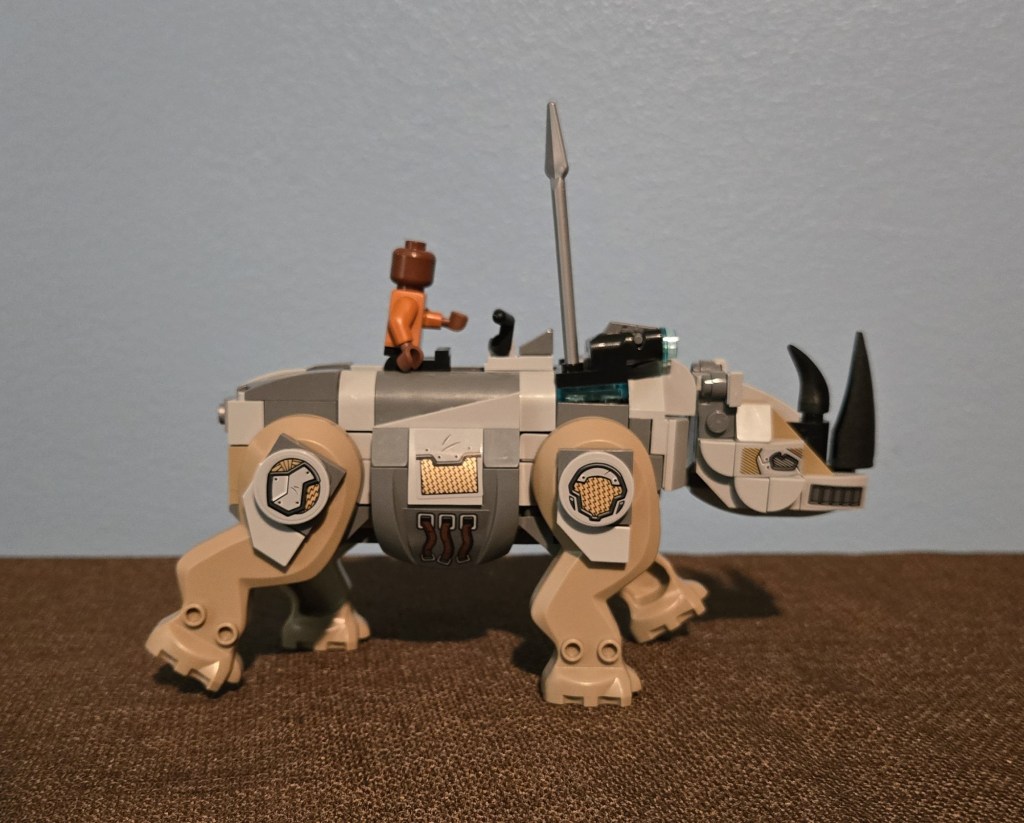
Lego Rhino (thanks to my grandson Kevin)
I had trouble deciding how many F’s to give. Started with 3. At one point I gave 5 Fs. And finally settled on 4 Fs. I lost Faith (in more ways than one – but that is now another blog to be written) due to length constraints.
When Blue Bloods started its lengthy TV run, I was not a major fan but watched it every week. Tom Selleck was the main draw and it was a good background show – i.e. no need for rapt attention but a reasonably well written and acted police drama. And then one episode, the character Danny Reagan, an NYC detective, played by Donnie Wahlberg interacted with a psychic. The psychic’s psychic abilities became a key to solving the case. That was the last Blue Blood’s episode I watched. Skip forward many years to this past week. I was listening (books on tape) to the fiction novel Colored Television: A Novel. Started out strong and then the main character described meeting her now husband with the aid of a psychic. For what I believe is the first time, I stopped listening to a book and moved on to another. Obviously, but maybe not quite so obviously, these two incidents have a common thread – introduction of a psychic as a “fact” within a fictional environment. The not so obvious element to this connection is that I have enjoyed many TV shows, movies and books in which a fantasy character, such as a psychic, plays a central role. The difference is the starting point. Is the media a fictional story set in today’s actual world? Then putting in pseudo-science (remembering that pseudo means, rightfully so, fake and does not mean alternate) elements is fakery. Is the media a fantasy story (and for this blog only I am combining fantasy, sci-fi and alternate universe under the fantasy label)? Then a pseudo-science element, if properly fitting the overall story’s architecture – is as the genre suggests, fantasy, and not fakery. So I can enjoy Star Wars with the Force, witches, and other fantastical elements. Even Star Trek with its Q and other-worldly characters dating back to the eeriest episodes such as Charlie X, can mix a bit more fantasy than fiction into their sci-fi genre. And I love both Star Wars, Star Trek and the more fully fantasy worlds such as Lord of the Rings. Perhaps the difference is that in fantasy, one is entering an escapist word not built on fact. But if the genre is meant to be in the real world, then fakery (pseudo-whatever) is a jarring and non-factual road I cannot abide.
Before going on, let me step back and be clear – this is about my personal preferences for myself. Others may love the interlacing of fantasy and fiction no matter what the genre. Others dislike all fantasy and, god forbid, there are even some who do not like sci-fi in any format. I am not writing to convince anyone to change their preferences and philosophies, only to explain my own.
I first mentioned one of my favorite podcasts, Our Fake History (OFH), in the blog The Other. The podcast started as a labor of love by Sebastian Major, self-described as “a teacher, musician, and storyteller who is passionate about all things weird and wonderful from the past.” The podcast tagline is “what’s fact, what’s fiction, and what is such a good story it simply must be told”. 233 episodes in (actually more when the patrons-only episodes are added in) and it is always a treat. Episode 233 is about the myths surrounding werewolves (one interesting note from the podcast: while the myths date back thousands of years, the full moon and silver bullet aspects only date to the legendary 1940’s film The Wolf Man and the less than legendary sequel Frankenstein Meets the Wolf Man.). The tie-in is from the 1600s. With the Renaissance came an understanding (at least for some) that people could not literally transform into a different being. Okay, then how explain the people who either believed themselves to be werewolves or believed they had encountered one. The “obvious” explanation was that witches were casting spells to make people hallucinate. So one fakery (Werewolves) denied by transference to another (Witches). Perhaps this is rooted in a deeper truth about how humanity did and still does view the physical vs. the mental. The physical, in this case the human “being”, cannot be transformed physically into a different werewolf “being”. This keeps everything tangible in a non-transformable state and provides a comfort of sameness. How one is today, is how one is tomorrow. But the unseen, the mental transformation of belief of what one is or what one sees, required an explanation that itself was physical – so witches are the culprit. Even today, we grapple with how, or even if, we treat those beset by mental disorders or mental differences or conditions. Transformation can be so fantastical (werewolf), needing to be explained by an outside force (witches); and yet transformations can be so factual (true to oneself), needing only to be accepted as part of our humanity.
In Knife: Meditations After an Attempted Murder, Salman Rushdie writes about the events before, during and after the knife attack in 2022 that nearly ended his life and left him half-blinded and severely injured. A fascinating book that I highly recommend. I had only known him through the news and the fatwa placed on him by Ruhollah Khomeini. I had not realized that Mr. Rushdie was a fictional writer who combined “magic realism with historical fiction” (Wikipedia). That alone made his writing a perfect fit for this blog. But what really caught my attention was his self-debate when, as an atheist, he was confronted with people proclaiming his escape from death as divine intervention. If I wanted to drag this blog into a mega-blog I could have put the missing fifth F (Faith) back in the mix. But for now, I will note the questions he asked himself about his factual atheistic belief? (non-belief?) vs. his writings which relied on fantasy and fiction. And so he gave me the perfect ending to this blog with this quote: “ I wanted to say: I believe that art is a waking dream. And that imagination can bridge the gulf between dreams and reality and allow us to understand the real in new ways by seeing it through the lens of the unreal.”


 Rhino Ramblings
Leave a comment