

A one of a kind Rhino and a special Flaming River Con tote bag
Due to an exceptionally high work-related period of stress over the past few weeks, I have not had a moment to contemplate much less write a post. Just prior to the all-consuming and quite honestly psychologically disabling (I will hold on to that topic perhaps for the next post) period, I had the very enjoyable pleasure of attending and speaking at the Cleveland Flaming River Con (https://www.flamingrivercon.com/). As they advertise themselves: “Midwest’s first Queer Geek Con! Your queer destination for everything geek, nerd, and fandom.” It was my first time attending a “Con” of any type much less as a featured speaker. I want to thank the Board for inviting and welcoming me. It was a wonderful event.
I speak often but almost always to Government and Industry Procurement professionals about the exciting world of IT Contracts (ha!). Speaking to a group of self-anointed nerds was a fun challenge to prepare for (there is also a side story about “what to wear” that I will defer for now). I took a 3 prong approach: start with solidifying my own nerdness (starting with being a member of the Star Trek TOS (The Original Series for you who are not nerds) fan club in the original airing; then on to my college life and NASA career; ending with my 90’s transition and my 2020’s re-emergence. I touched on many themes along the way. The focus for this post is representation in sci-fi / fantasy. (Side note – Tony Isabella was the other- and in many ways the more illustrious speaker. They are the creator of the DC Comics’ first major African-American superhero, Black Lightning).
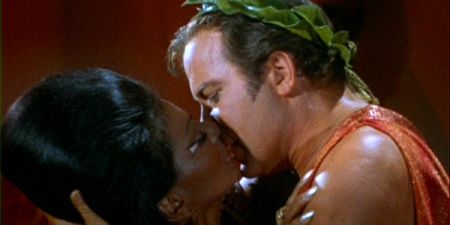
I presented three timelines: the mid-60s; the late 90s and recent times. The mid-60’s setting was the episode “Plato’s Stepchildren” on Star Trek and the “first” inter-racial “kiss”. The quotes around first and kiss are deliberate. There is a debate as to what constitutes being the first inter-racial kiss on TV and even what is meant by the term inter-racial– see https://en.wikipedia.org/wiki/Kirk_and_Uhura%27s_kiss for a detailed discussion. Beyond the general debate on timing and meaning, the kiss itself is problematic, especially in hindsight. NBC required that there was no lip touching. There was also no implicit or explicit romance depicted between Captain Kirk and Lieutenant Uhuru. In fact, the kiss was against their wills, forced by a third party – you know aliens and all that. And yet despite those caveats I still remember the momentous event and the controversy it drew. Looking back one can place today’s world view on the episode and find that it perpetrated a racist view in which a white male could only conceivably be kissing a black woman through a coercive third force and not as a mutually, desirable action. But that is the lens of backwards viewing. In the 60s world, this truly was a breakthrough TV event and should be celebrated as such (at least the Star Trek nerd that I am, will hold to that opinion).
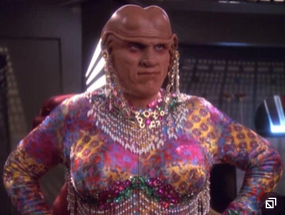
As I was preparing my Con talk, I happened to watch a Star trek DS9 (Deep Space 9) episode that clearly wanted to break through some barriers but in the end failed miserably. In Profit and Lace, a male character, Quark, has (temporary) male-to female surgery in order to seduce a fellow Ferengi (the alien race) and save the day and supposedly learn important lessons about sexism. As I watched the episode in today’s world I was shocked by the entire storyline. The episode is noted, and rightly so, as one of if not the worst DS9 episode. For perspective, let’s turn back the clock to its first airing in 1998. Admittedly I do not remember my reaction at the time (I know I watched it because…, see note above about being a Star Trek nerd). This was just a few years after my surgery and trans representation was still a novel concept in TV. A depiction of a main character transforming their gender, even if temporarily, while not as momentous as the “kiss” was an attempt at a step forward. And I am guessing, I internally was thrilled at the attempt. But much like couching a controversial kiss with an unwantedness, the gender change was made with over-the-top jokiness about a male trying to act like a female filled with sexist tropes. The episode was marred from the opening scene of Quark sexually harassing one of his servers. The heavy-handed goal was to bookend and show how “he changed through his awakening of his feminine side. The twist at the end was that the sexually harassed server returns seeking a sexual encounter with Quark and Quark “heroically???” declines. It is a mess of a storyline. This contrasts with the series as a whole which did touch, if not always landing, upon both gay and the trans themes in a positive manner.
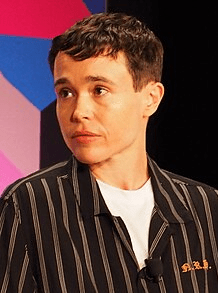
Which leads to today. I am not going to sugarcoat the world today and say that interracial (and gay) kisses are not still a problem for some – maybe too many; nor that joking and minimizing sexual harassment and gender identity issues, rather than a thoughtful consideration, is not still prevalent. There are, nonetheless, positive signs. Elliot Page’s journey provides a representative real-life and TV show narrative to be proud of. For those who are unaware, Elliot Page was born and acted for many years as Ellen Page (one could say acted in real life and on TV and movies as Ellen). While playing Vanya Hargreeves in the TV show The Umbrella Academy, Elliot came out as trans. A TV show could have handled this in many positive and negative ways, The production team and cast and I believe in full coordination with Elliot, the next season re-introduced Vanya as Victor. A few explanatory words among the ensemble cast were exchanged, and everyone just moved on with the Umbrella Academy story. Yes, there was an acknowledged difference, but it was not the focus of any story line. No attempts to explain it away or make it a comedic twist. I have no doubt Elliott has and will have negative fall out from his transition and out-spokenness. But he should be proud of himself, and all those associated with the show.
This is a small sample size. My focus for the Con talk was on the sci-fi genre. I would be remiss to not note many other episodes and entire shows such as Bosom Buddies, and of course Ellen. Or more recently Somebody Somewhere which has a diverse cast that does not make their diversity the theme, but rather an aspect of who each character is. But no sci-fi or fantasy in those.
For now, I hope the future holds fewer forced (although perhaps is some cases such as “the kiss” still momentous) messages and more normalized representation of diversity in life and TV and all other media.
 Rhino Ramblings
Leave a comment