
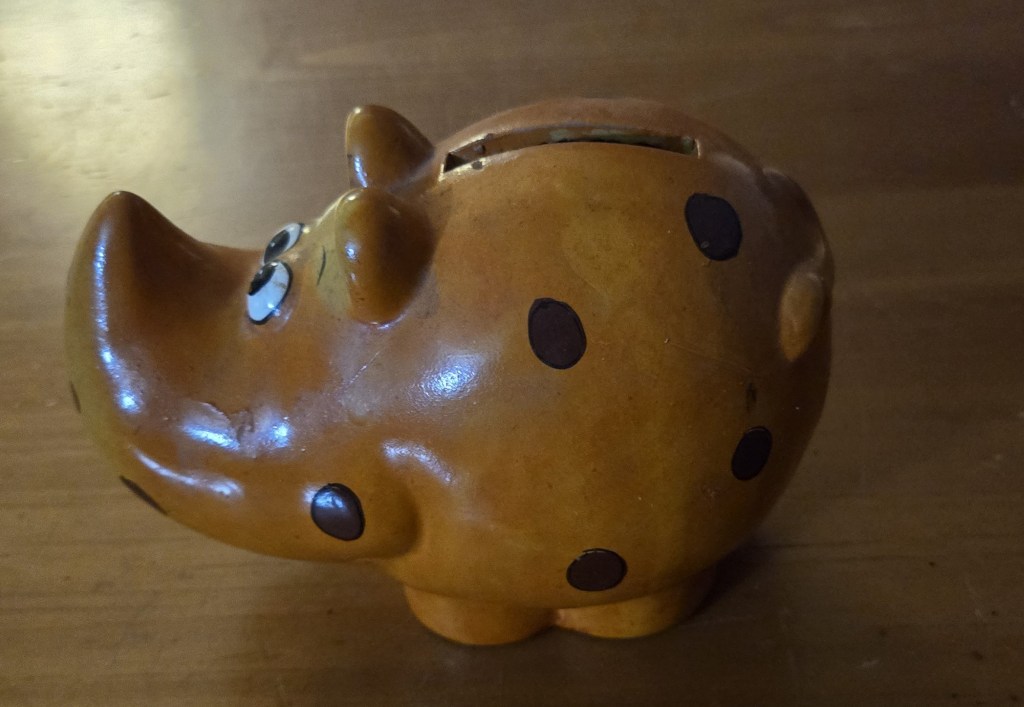
Piggy Bank or Rhino Bank — names matter
Last week I had the honor to be on a panel discussing issues and opportunities for a supervisor whose staff includes a trans person. Being both trans and a supervisor, I hopefully was able to provide extra perspectives. But that is not what this blog is about. Along with HR, General Counsel, and DEIA staff, we were joined by a young FtM (Female to Male) scientist who brought thought-provoking insights for us all to consider. They (we will come back to pronouns later) became animated (I originally wrote “emotional”, but that is a gender charged term that can evoke the wrong imagery and connotation) when describing the effects of dealing with paperwork and at times people referencing their original birth name. Initially I could not relate to the strength (you see if I used “emotional” the tendency is to equate it to weakness and their was nothing weak in their telling) of their feelings. Afterwards, I contemplated my own relationship to my birth name. I may not outwardly express it and inwardly try to repress it, to be truthful, the mention and even sight of my birth name evokes deep apprehension, angst, dysphoria and a host of negative emotions (I accept all connotations of the word “emotion” as it relates to me – I just want to ensure I am not placing those connotations on others).
Let’s start with the name itself. Wait, give me a second, ummmm ok deep breath – my birth name was Joseph Robert (middle name is important later). Sure, I can pretend this is not emotional. I mean it is just a name. But I had to hesitate because I have avoided stating that name for almost 30 years except under extreme duress. When I started my transition journey, I believed the name was benign. In deciding on my actual name (and thanks to Pennsylvania law, the name now on my official state birth certificate) I deliberately chose Joanne Rose. The names kept my initials the same. And Jo is an acceptable nickname for both Joseph and Joanne. I thought that might allow for wriggle room with those not appreciative of my journey (like my parents) and any resistant staff. I soon realized that was delusional on my part. The name mattered. Jo might be an acceptable nickname for some Joanne’s. It is not for me. It shoots an arrow into me whenever someone does use it. The turmoil that drove my life for the first 35 years becomes fresh anew. And it is now almost 30 years later. For the panelist, they were just a few years in and so are still hit with outward and inner emotional upheaval when faced with reminders through a not yet changed document or a personal mis-use.
Pronouns – I am a woman, and my pronouns therefore seem obvious to me – she and her for those who are uncertain. I hesitated with using the feature in NASA’s systems to indicate my pronouns and am actually a little jarred when I see “She/Her” every login. By emphasizing how people should refer to me could be seen as indicative that my womanhood is not accepted or acceptable and so I must keep forcing that acceptance. Or I just need to get over myself and recognize that representation and visualization are important. An LGBTQIA+ ally mentioned in a meeting that after adding their pronouns, they were thanked by LGBTQIA+ members who appreciated the goal of knowing and respecting pronoun usage as a norm for all to follow. This made me realize that stating my pronouns are she/her is not for me or at least not for me alone. It is a step in moving the narrative away from “why do you have to tell me your pronouns” to “why isn’t everyone doing so”. It is a sign of recognition and acceptance. Respect for the person whose pronouns are either recently changed or are non-binary in part or full or simply expressing clarity for others. Coincidentally shortly before the panel a friend related how her daughter was exasperated with her forgetting to use “they” when referring to her daughter’s friend. My friend asked me to explain the “they” pronoun. I stumbled and mumbled. Later at the panel the FtM panelist gave a very succinct, meaningful and personal explanation of what “they” meant to them. When they finished, I thanked them and rued that we were not taping as their statement would be useful as a reminder to me and as a clip to others trying to understand the meanings. But, then again, I do not need the words that they spoke. I only need to respect their self-actualization, their self-awareness, their self-being and the expressiveness that matches those self-feelings.
A related side note. I have become less tolerant around others imposing a nickname on others or simply using a form of someone’s name. If, for example, someone introduces themselves as Michael Smith, I will ask if they prefer Mike or Michael before just jumping in with Mike (I am not going to claim 100% correctness as I can barely remember if I know someone much less remember their name). Names and pronouns are important whether for support of a gender-specific personal identification or just because we all want to be known by who we are and how we prefer the world to identify us.
 Rhino Ramblings
Leave a comment